
About the book
A novel about arithmetic,
not irony
Six months before the story opens, Halverson Group approved Project Meridian — a restructuring that eliminated 40% of their engineering org. The board deck said AI could do 80% of what those people did. Nobody asked Josh Renner. He found out in the all-hands.
By month three, the pattern was clear: the company had successfully eliminated the salaries while discovering it could not eliminate the knowledge. It was paying for both, separately, at a premium.
The Reduction is modeled on Gene Kim's tradition — short, fast-cut chapters, fully dramatized scenes, real technical depth — but written as genuine literature, not business parable. The concepts are accurate enough to pass the exam. The human story is true enough to sting.
"The loop doesn't end because Claude decides to stop. It ends because we tell it to."
Written through five acts covering real agentic AI patterns — tool design, MCP integration, Claude Code configuration, structured output, and context management — every concept arrives through consequence, not explanation. You understand why something matters at the same moment Josh does.
The technical arc
Five acts. Five domains. One argument.
The technical throughline covers the full CCA-F curriculum — rendered through character perception and consequence, not definition or exposition.
Act One
Agentic Architecture & Orchestration
Josh inherits a broken support agent. 12.4% error rate. More instructions make it worse. The loop doesn't behave the way he expects — because he doesn't understand the loop.
Act Two
Tool Design & MCP Integration
Priya builds a productivity agent with 18 tools. It calls the wrong one on every query. The problem isn't the code. It's the descriptions the model can read.
Act Three
Claude Code Configuration & Workflows
14 features. 3 developers. 6 weeks. Claude Code is capable but unconfigured — and there's a difference between a powerful tool and an aligned one.
Act Four
Prompt Engineering & Structured Output
A regulatory filing arrives with wrong capital ratios. The extraction pipeline produced numbers. They were just wrong. Describing output and demonstrating output are different things.
Act Five
Context Management & Reliability
The systems aren't failing. They're drifting. No errors. Just wrong. The system is lying in a way that looks like the truth.
Throughout
The Citizen Developer Thesis
AI doesn't replace engineers. It requires a smaller, more senior technical org to guide and govern it. Halverson stumbled toward this by accident, through pain.
The cast
People who carry the argument
The Reduction is not a parable with roles attached. These characters have histories, blind spots, and wounds — and they carry the book's central argument in their actions, not their speeches.
Josh Renner
Senior Development Manager · Protagonist
25 years in software, moved into management in his late 30s. His skill is understanding what teams need and getting obstacles out of their way. Project Meridian removed the thing he was good at managing. His flaw — managing AI like he manages people — drives every major failure in the book.
Mary Cate Donnelly
EVP of IT and Cybersecurity · Mentor
Started her career as a sysadmin in 1987. Has lived through every hype cycle. She's been studying Claude documentation for four months, on her own time. She doesn't share knowledge in lectures — she shares it in questions. "What happens when the tool call fails?"
Tomás Reyes
Former Senior Engineer · Independent Contractor
Six years at Halverson. Built the core of the deployment pipeline. Re-engaged at $165/hour six weeks after his elimination — the fourth call HR made when the payroll integration broke. He picked up on the second ring. He is the specific, personal cost of treating institutional knowledge as a line item.
Bea Okafor
Former Staff Engineer · now Compliance Technology Lead, First Meridian Bank
She sent a single Slack message after her elimination notice — I'm disappointed — and went offline. Hired within six weeks by one of Halverson's largest clients. She is now on the other side of the relationship. The knowledge that walks out the door and ends up across the table.
Reader resources
Go deeper with the material
The appendices in the book map every concept to the chapter where Josh encounters it. These downloads extend that work — and the practice test helps you verify your own understanding.
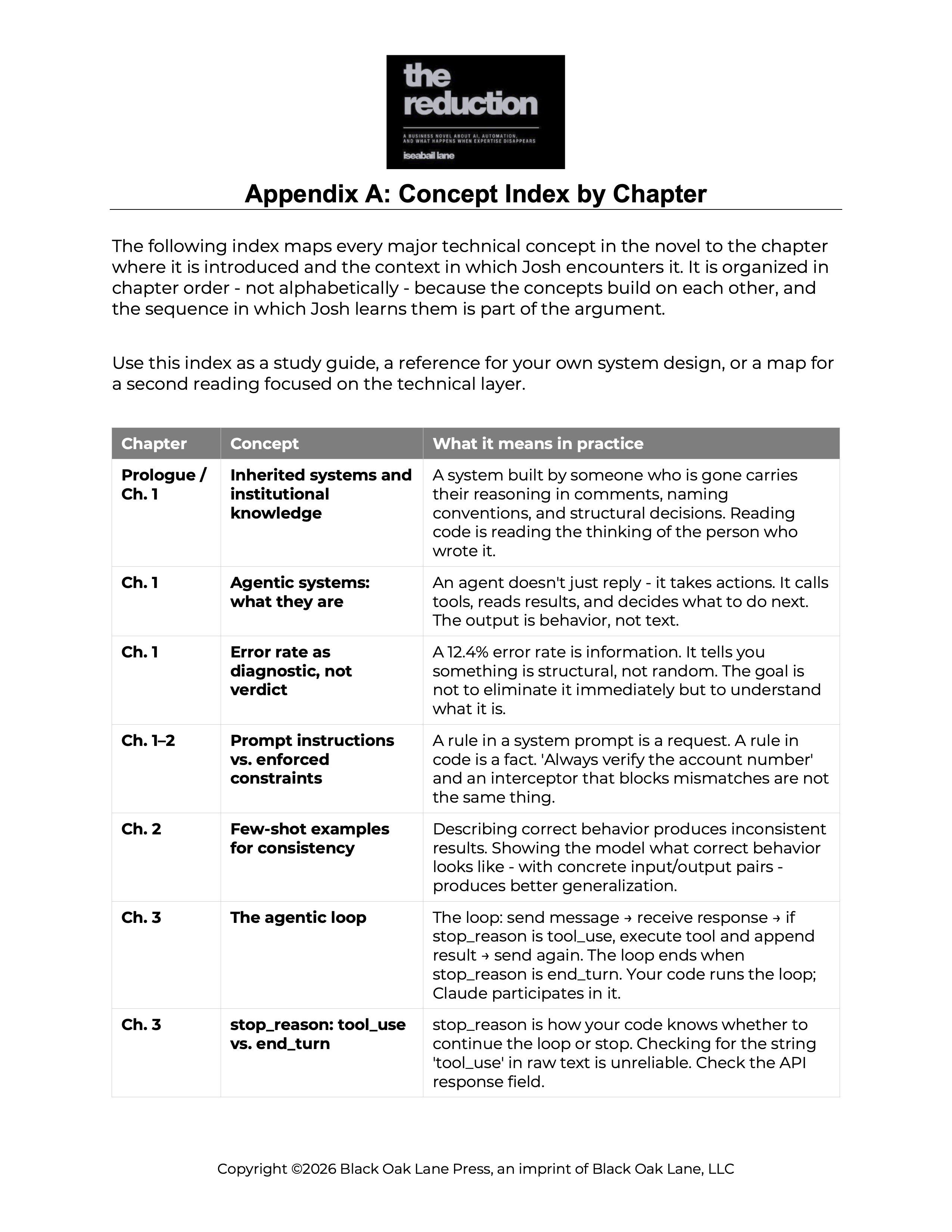
Appendix A · PDF
Concept Index by Chapter
Every major technical concept mapped to the chapter where Josh encounters it, organized in chapter order — not alphabetically — because the sequence in which Josh learns matters. Use as a study guide or second-reading map.
Download PDF →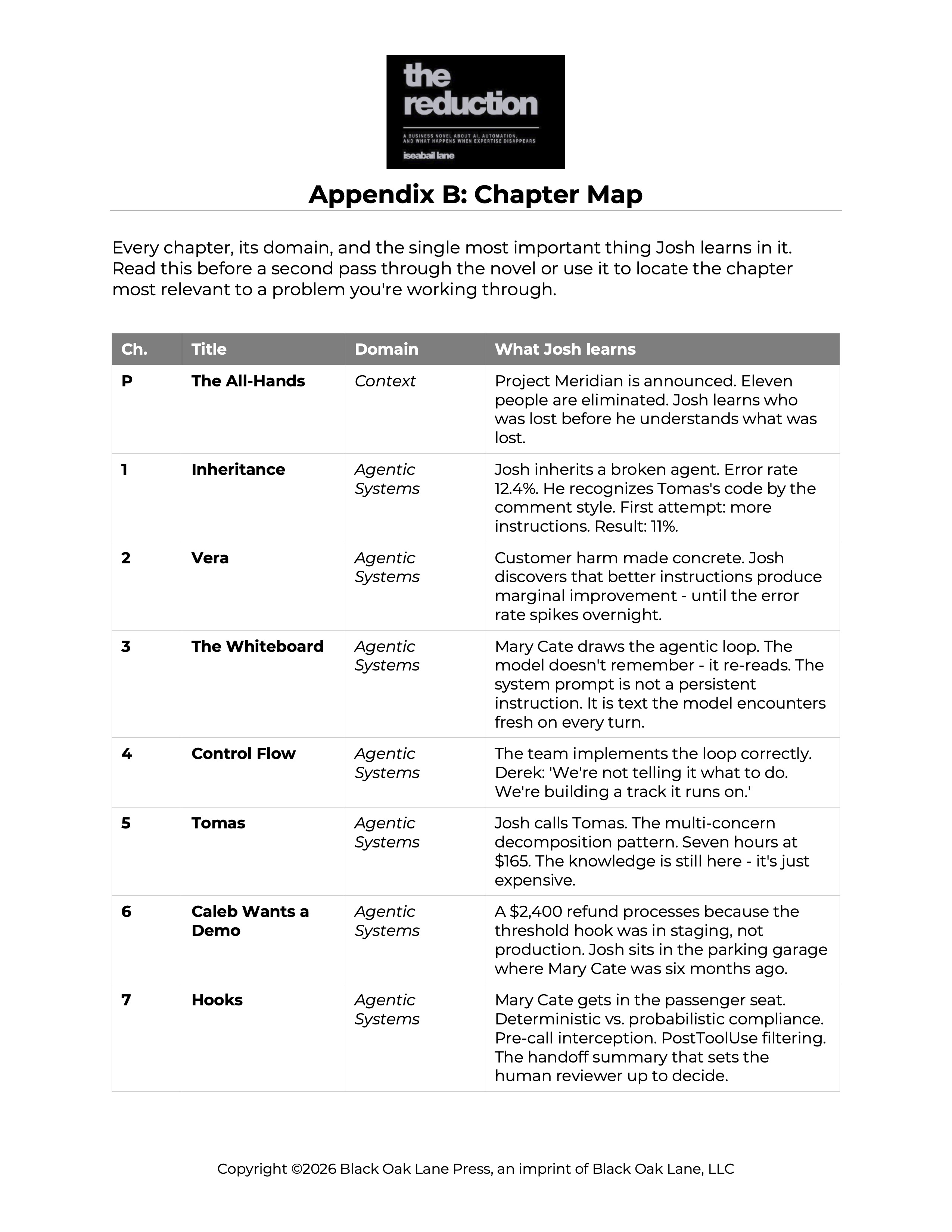
Appendix B · PDF
Chapter Map
Every chapter, its domain, and the single most important thing Josh learns. Read before a second pass through the novel — or use it to locate the chapter most relevant to a problem you're working through right now.
Download PDF →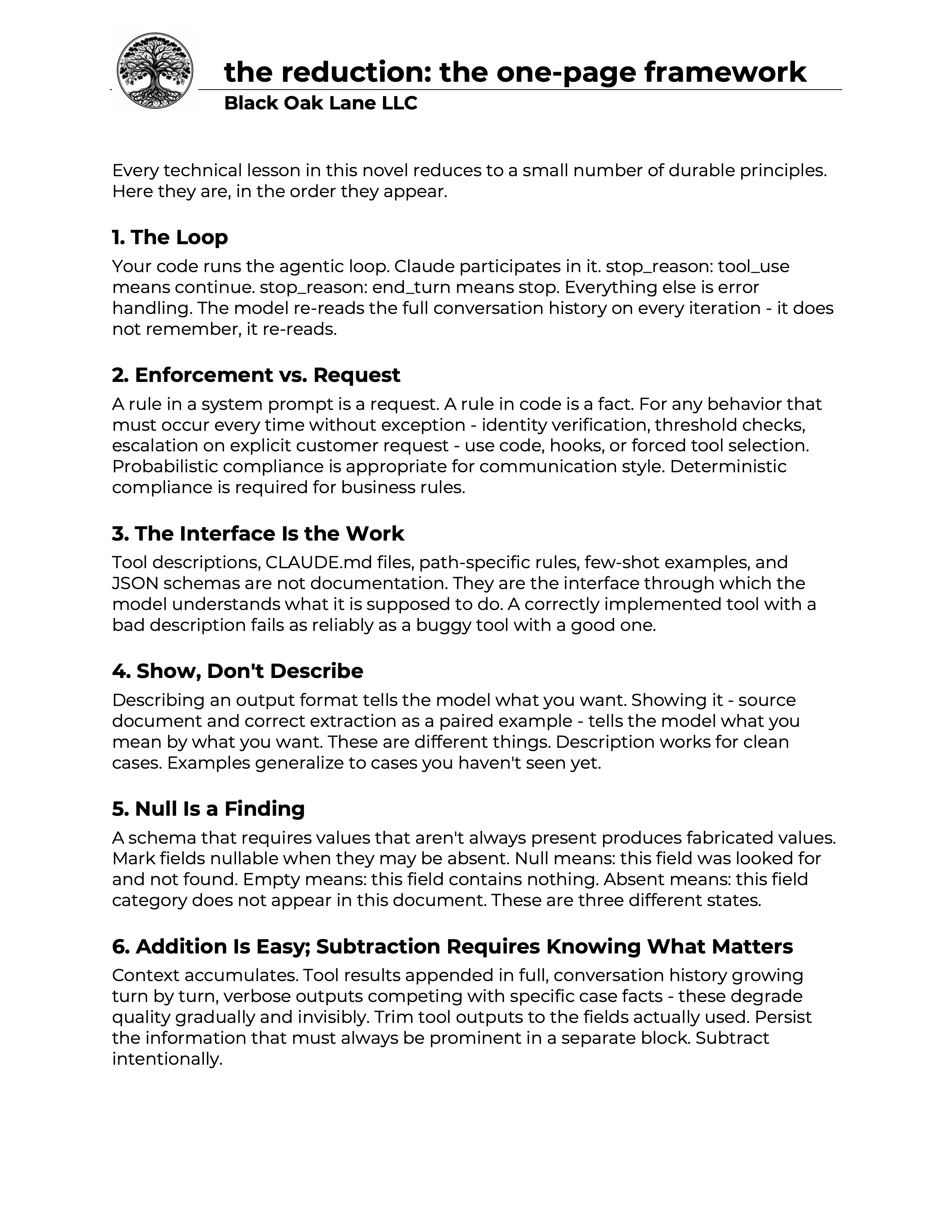
Appendix C · PDF
The One-Page Framework
Every technical lesson in the novel reduces to ten durable principles. The Loop. Enforcement vs. Request. Show Don't Describe. Null Is a Finding. The Knowledge Doesn't Disappear. Here they are, in the order they appear.
Download PDF →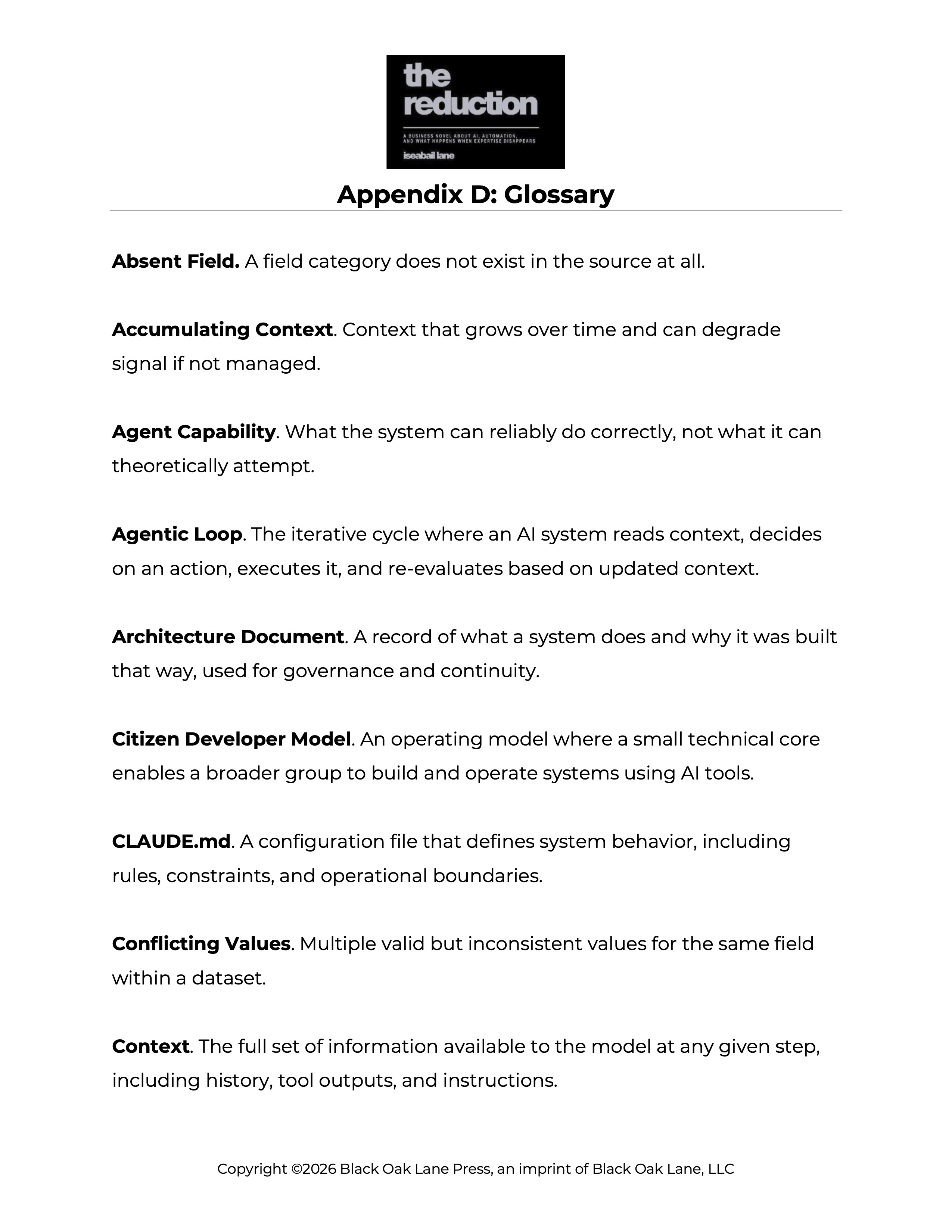
Appendix D · PDF
Glossary
Plain-language definitions for every technical term used in the novel — from Absent Field and Agentic Loop to Tool Call and Schema Validation. A reference for readers and a study aid for the CCA-F exam.
Download PDF →Series
Leading on the Blended Edge
For leaders navigating organizations where human expertise and AI capability increasingly overlap. The Reduction is Book 1. Book 2 follows Mary Cate into the security and compliance consequences of what Josh built.